The Groom's Guide to Classic Tailoring
A practical guide to choosing, fitting, and accessorizing your wedding suit or tuxedo so the photographs hold up for decades.
Introduction: The Value of Timeless Tailoring
First, the most important point: it is your wedding day. You can and should wear whatever makes you feel confident, comfortable, and true to your own style. There are no absolute rules, only traditions and guidelines to help you look your best.
Looking back at the history of menswear, it is easy to spot the decades by their fashion trends. The 1980s and 1990s gave us boxy power suits with oversized shoulders, draped chests, and trousers pooling around the ankles. The late 2000s and 2010s swung to the opposite extreme, with shrunken suits that looked two sizes too small and restricted natural movement.
The risk of dressing for a specific trend on your wedding day is that your photographs will quickly look dated. You want the focus to be on the day itself, not on the era-specific cut of your jacket.
Classic tailoring sidesteps these cycles. It is built around the natural proportions of the human body, not the mood of a particular decade. By focusing on a proper fit, timeless silhouettes, and structural balance, you ensure the look will hold up. When you open your wedding album in thirty years, you will see a sharply dressed groom, not a fleeting trend.
This guide walks through those classic tailoring principles, so you can feel comfortable on the day and look right in the photographs.
Choosing Your Suit: Tuxedo vs. Classic Suit
At the very top of formal menswear sits "White Tie," which features an evening tailcoat, a white piqué waistcoat, and a white bow tie. This dress code is rare in North America today, so for most weddings the choice comes down to two options: the Tuxedo (Black Tie) or the Classic Suit.
The Tuxedo (Black Tie)
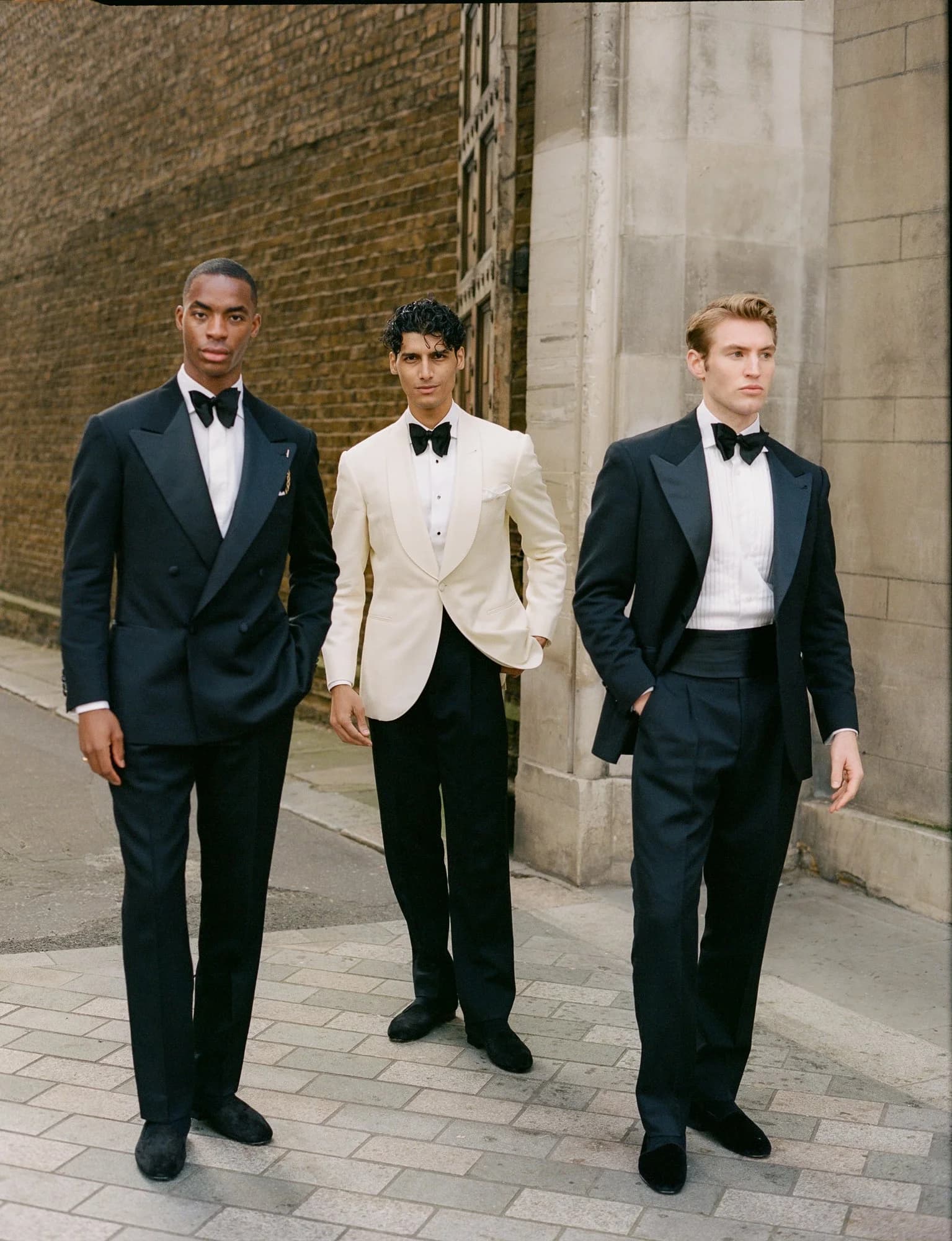
A tuxedo signals occasion. It is designed for celebration, with satin facings on the lapels, buttons, and trouser stripes that provide an elegant contrast against the wool. Traditional menswear rules treat black tie as evening wear, but American weddings have largely set this rule aside, partly because formal morning suits are practically nonexistent here. You can wear a tuxedo for your wedding regardless of the time of day.
Venue is worth considering, though. A tuxedo can feel slightly out of place in a casual or rustic setting like a barn or a wooded outdoor ceremony.
The Classic Suit
For an outdoor wedding or a less rigid dress code, a classic suit is a strong choice. A well-constructed suit in a foundational color like navy is one of the most versatile pieces a man can own. It looks sharp next to a bridal gown, and its life extends well beyond the wedding day, into future weddings, work events, and dinners out.
The Rule That Matters Most
Whether you go with a tuxedo or a classic suit, fit is the deciding factor. A well-tailored suit will always look better than an ill-fitting tuxedo. Get the fit right and you will look composed and at ease in every photograph.
Renting vs. Buying
Whether to rent or buy your wedding attire usually comes down to two factors: your overall budget and the financial expectations you are placing on your groomsmen. There is no wrong answer, only the choice that fits your specific celebration and group.
The Case for Renting
If you have a large wedding party, asking every groomsman to buy a new suit can be a heavy financial ask. The main benefit of renting is the accessible price point. It lets your group wear matching garments without a large upfront cost from guys who may not wear a formal suit very often.
When renting, it helps to keep an eye on fabric and fit. Rental suits need to withstand constant wear and frequent dry cleaning, so they are often made from durable synthetic blends that do not breathe as well as pure wool or linen. The fit is also generalized to accommodate many body types, which means the silhouettes can lean either too slim or slightly boxy, with limited options for personal tailoring. Knowing this upfront helps you set the right expectations.
The Case for Buying
If your budget allows, buying your wedding suit or tuxedo is a solid long-term investment. A ready-to-wear or made-to-measure garment lets you choose breathable natural fabrics and a fit tailored to your proportions. You also walk away with a versatile suit you can wear for years, including future anniversary dinners and other formal events.
If you go this route and want your groomsmen to buy their suits as well, have an open conversation early about what everyone can comfortably afford. It is better to address the cost directly than to leave anyone guessing.
A Middle Path
You do not have to pick one approach for the entire wedding party. A common and practical compromise is for the groom to buy his suit while the groomsmen rent matching ones. This lets you invest in a garment you will keep, while sparing your groomsmen the larger expense. If you go this route, coordinate the rental choice carefully so it aligns with your suit in color and overall weight.
On Matching
Whether you rent or buy, visual cohesion brings a sense of harmony to the wedding party. If your groomsmen are sourcing their own garments, not every detail needs to match exactly. Small variations in tie patterns, pocket squares, or shoe styles can add character. The core fabrics, however, should be consistent. Mixing a lightweight worsted wool with a heavy winter flannel, or a matte natural fiber with a shiny synthetic, creates a visibly disjointed look. Keeping the main fabric consistent ensures everyone looks unified.
Sourcing Your Suit: The Tiers of Tailoring
When shopping for your wedding suit or tuxedo, you will encounter three main categories of tailoring. Understanding the differences will help you set a realistic budget and choose the right route for your timeline.
Ready-to-Wear (RTW)
Ready-to-Wear garments are suits you buy off the rack at a department store or menswear shop. This is the most accessible and budget-friendly option. Prices for a decent RTW suit typically range from $400 to $1,500, depending on the brand and fabric quality.
Because these suits are cut to fit a statistical average, they will almost certainly not fit you perfectly out of the box. If you go the RTW route, factor the cost of a local tailor into your budget. A $400 suit that has been properly nipped at the waist and hemmed to the correct length will look better than a $2,000 suit that fits poorly.
Made-to-Measure (MTM)
Made-to-Measure is a strong middle ground and the most popular choice for grooms looking to invest in a good suit. With MTM, a tailor or stylist takes your measurements and adjusts a pre-existing base pattern to fit you. This route also lets you customize stylistic details, from the lapel shape and fabric to the inner lining and the buttons.
Prices for MTM typically start around $800 and can reach $2,500 or more for premium fabrics. Because the suit is cut specifically for you, the fit is meaningfully better than off-the-rack. Keep in mind that MTM garments take several weeks to produce, so you need to start the process a few months before the wedding.
Bespoke
Bespoke is the top tier of tailoring. Unlike MTM, there is no pre-existing pattern. A master tailor drafts a new pattern from scratch for your body, which requires multiple fitting sessions and takes many months to complete by hand.
Prices for true bespoke tailoring usually start around $3,000 and can exceed $10,000. The honest reality is that most grooms do not need to go bespoke. A well-made MTM suit, or a properly tailored RTW one, will give you an excellent look on the wedding day without the larger price tag.
Suit Construction: How a Jacket Is Built
As you start shopping for a suit or tuxedo, the internal construction matters as much as the wool on the outside. How a jacket is built internally determines how it breathes, how it drapes, and how long it will last.
Fused Suits
Most inexpensive, mass-produced suits are "fused." This means the outer fabric is glued to the inner lining to give the jacket its shape. Fused jackets tend to feel stiff, do not breathe well, and never quite mold to your body. Over time, especially after a few trips to the dry cleaner, the glue can degrade and cause the fabric to bubble and ripple. It is best to avoid fused suits for your wedding.
Canvassed Suits
A higher-quality jacket is "canvassed." Instead of glue, tailors use a floating layer of canvas, typically a blend of horsehair and wool, sandwiched between the outer fabric and the inner lining.
- Half Canvas. The canvas runs from the shoulder down through the chest. This provides structure where you need it most while keeping the price accessible. It is a good balance for most grooms.
- Full Canvas. The canvas runs from the shoulder all the way to the bottom hem. This is the standard at the top end of tailoring, though it costs more than half-canvas. It allows the entire jacket to breathe and lets the fabric mold to your body over time, which results in a better long-term fit.
The Pinch Test
You can check the construction of any suit using the pinch test. Go to the chest area of the jacket, slightly below the lapel. Pinch the fabric on the inside and the outside, then gently pull them apart. If you can feel a distinct, free-floating third layer of material slipping between your fingers, the jacket is canvassed. If the chest feels like one thick, stiff piece, it is fused.
Mastering the Classic Suit: Stylistic Choices
If a classic suit is the right path for your wedding, there are several ways to personalize the garment to fit your style and the venue. The details you choose will shape how formal, modern, or timeless the suit reads.
Colors
Navy, charcoal, and mid-grey are classic choices, but there are absolutely no limits on what color you can choose. These foundational colors are incredibly versatile and can easily work for many occasions long after the wedding day. For summer weddings, especially those with a beach or tropical vibe, light colors like cream, beige, and light blue work exceptionally well. The only recommendation is to avoid overly bright colors, as those fabrics can reflect harsh tones directly onto your skin.
If your heart is set on wearing black, you are much better off going the tuxedo route. A standard black suit can easily look like you are working as a bodyguard, in hospitality, or attending a funeral. This is especially true if it is a standard single-breasted jacket with notch lapels. A tuxedo elevates black fabric to its proper celebratory status.
Fabrics
When it comes to fabrics, always consider the season and your comfort. A lightweight tropical wool or linen is fantastic for the warmer months. Just keep in mind that linen naturally creases, giving it a wrinkly look that feels a bit more relaxed and summer-like. For a reliable, year-round choice, look for a Super 110s (S110) wool. It offers a great balance of drape, durability, and a refined finish. While finer fabrics like Super 150s (S150) feel incredibly luxurious to the touch, they are much harder to maintain, wrinkle easily, and have more limited longevity.
For winter weddings, you may consider heavier fabrics like flannel or tweed. However, remember that you will mostly be indoors for the reception. You will be moving around and dancing, so you may not want to get too hot. A high-quality mid-weight wool often strikes the perfect balance.
Two-Piece vs. Three-Piece
A standard two-piece suit includes a jacket and trousers. Adding a matching vest turns it into a three-piece. The vest adds a layer of formality and a touch of vintage character, and it has the practical benefit of keeping you looking put-together when you take your jacket off at the reception. The trade-off is warmth. The extra layer of fabric will make you noticeably hotter, which is worth thinking about for a summer or outdoor wedding.
Single-Breasted vs. Double-Breasted
The single-breasted jacket is the standard choice for most grooms. It is universally flattering, easy to wear, and timeless. A double-breasted jacket is a strong alternative. It carries more visual weight and adds a layer of formality, and it solves a small but persistent problem: the "shirt triangle." Because the overlapping fabric of a double-breasted jacket covers the waistline entirely, your shirt will not peek out beneath the button, even with lower-rise trousers.
If you are considering a double-breasted jacket, the button configuration matters as much as the style itself. A 6x2 (six buttons, two of which fasten) is the most traditional and balanced layout, with the buttoning point at the natural waist. A 6x1 fastens lower, creating a deeper V at the chest that elongates the torso, which can be especially flattering on shorter or stockier builds. A 4x1 has a higher, more compact buttoning point and reads as sportier and more modern, suiting leaner frames well. The right configuration depends on your proportions more than your height alone.
One note on wearing a double-breasted jacket: it should generally stay buttoned whenever you are standing. Unbuttoning it loses the structured line that makes the style work.
Lapels
Your lapels frame your chest and shirt, and the two main options for classic suits are notch and peak. Notch lapels are the standard, versatile choice for single-breasted suits. Peak lapels point upward toward the shoulders, which broadens the chest visually and lengthens the frame. If you choose a double-breasted jacket, it should always have peak lapels, never notch. Shawl lapels are another option for double-breasted jackets, but only on tuxedos.
A good rule of thumb on width: your lapels should take up at least half the distance between your collar and your shoulder seam. A classic width of around 3.5 inches is usually a safe bet. Thin lapels tend to read as dated and can make a suit look cheap.
Shoulder Construction
The way the shoulder of your jacket is constructed changes the formality and feel of the suit considerably. It also interacts with your build, since the shoulder is where a jacket either reinforces or softens your natural proportions.
- Structured Shoulder (English Tailoring). This traditional style uses internal padding to create a sharp, defined shoulder line. It is the most formal of the three and works well for traditional or evening weddings. It also helps build width on narrower frames, since the padding adds visual presence to the upper body.
- Soft, Natural Shoulder (Italian Tailoring). Often associated with Neapolitan tailoring, this style uses little to no internal padding. The jacket follows the natural slope of your shoulder. It is comfortable and has a more relaxed feel, which suits outdoor, summer, or less rigid celebrations. It also tends to be more flattering on broader builds, since it does not add bulk to shoulders that are already wide.
- Roped Shoulder. A small, raised ridge where the sleeve meets the shoulder seam. It adds a bit of structured European character and sits between the formal English shoulder and the soft Italian one. It works well on most builds and is a good middle option if you are unsure.
Sleeve Details
The details at the end of your sleeves seem minor, but they signal quality and stylistic preference.
Functional vs. Non-Functional Buttons. Most ready-to-wear jackets have non-functional buttons sewn onto the fabric. The advantage is flexibility for alterations: a tailor can shorten or lengthen the sleeve without working around existing buttonholes. Higher-end Made-to-Measure and bespoke jackets almost always feature functional buttonholes, historically known as "surgeon's cuffs." Some men leave the final button closest to the wrist undone as a quiet signal that the buttonholes are real, though it is entirely optional.
Unfinished Sleeves. Some higher-end off-the-rack jackets bridge the gap by arriving with completely unfinished sleeves and a separate set of buttons in the pocket. This lets your tailor adjust the sleeve to your exact length before sewing the buttons on or cutting functional buttonholes.
Button Spacing. You also have options for how the buttons are arranged along the cuff, usually starting about 1.5 inches from the edge of the sleeve.
- Spaced. The buttons have a small visible gap between them. This is a traditional, conservative English style.
- Kissing. The buttons are placed so their edges just touch.
- Waterfall (Stacked). The buttons slightly overlap. This is a hallmark of Italian tailoring and adds a relaxed character to the sleeve.
Jacket Pockets
The style of the pockets on your jacket has a meaningful effect on the overall formality of the suit.
Patch Pockets. Created by sewing a separate piece of matching fabric directly onto the outside of the jacket. They have a relaxed, sporty appearance and are not the right choice for formal events like weddings. They suit weekend blazers and tweed sport coats better.
Flap Pockets. The standard, most common style. A tailored slit covered by a rectangular flap of matching fabric. Flap pockets are appropriate for a wedding suit. As a small styling option, you can tuck the flaps inside the pocket to convert them into a sleeker jetted style for the reception.
Jetted Pockets. Also known as besom pockets, these are the most formal option. A clean slit finished with narrow fabric welts and no flap. Jetted pockets create the cleanest, most uninterrupted silhouette. They are mandatory for tuxedos and a strong choice for a formal wedding suit.
Trouser Details
Modern suits often feature flat-front trousers, which give a clean, minimal look. Classic tailoring also embraces pleats. Single or double pleats add visual interest and provide extra room through the hips and thighs, which makes them more comfortable when you are moving or sitting. Paired with a slightly higher waist, pleated trousers create a clean, even drape.
When it comes to holding your trousers up, you have a few options. A traditional leather belt is common, but it visually cuts your outfit in half and leans toward everyday business wear. For a wedding suit, going beltless creates a cleaner, more elongated line. To achieve this, look for trousers equipped with side tabs—small fabric adjusters built directly into the waistband that let you fine-tune the fit.
Button-on suspenders, often called braces, are another option. Suspenders let the trouser fabric hang naturally from your shoulders rather than being cinched at the waist. This prevents the waistband from digging in when you sit and gives the trousers a cleaner drape, which holds up well in photographs.
These choices tend to work as a system rather than independent decisions. Pleated trousers pair naturally with a higher waist and suspenders, since the fabric is designed to hang from the shoulders. Flat-front trousers are more often worn beltless with side tabs, which keeps the front clean and minimal. Mixing the two approaches—flat-front trousers with suspenders, for example—can work, but the more traditional pairings tend to look the most balanced.
The Anatomy of a Proper Tuxedo
If you are committing to Black Tie, it is worth doing it right. A tuxedo is a specific garment with historical conventions that set it apart from a standard suit.
Lapels, Buttons, and Pockets
A proper tuxedo features either peak lapels or a shawl collar. Notch lapels belong on everyday business suits, not on tuxedos. Some manufacturers put notch lapels on tuxedos because it lets them use their standard suit patterns, but the result reads as a black suit pretending to be a tuxedo rather than the real thing. For a proper formal look, stick to peak or shawl.
The buttons on a tuxedo are not standard plastic or horn. They are typically covered in fabric, usually silk or satin, to match the lapel facings. Pockets should be jetted—clean slits with no flaps—to maintain the smooth, formal silhouette. If your tuxedo jacket arrives with flap pockets, tuck the flaps inside to create the same clean line.
Jacket Colors
The standard tuxedo jacket is traditionally black wool. Midnight blue is another historically accurate option for Black Tie. Under artificial evening lighting, pure black fabric can sometimes reflect a slightly greenish or dusty hue, while midnight blue actually looks deeper and richer than black. Both are traditional choices, and either will hold up well on camera.
An off-white or cream jacket is another classic option, though it is a more distinctive choice and not right for every wedding. It draws considerable attention and tends to suit summer weddings, destination settings, or daytime ceremonies better than formal evening receptions. If it fits the tone of your day, one effective approach is having the groomsmen wear traditional black or midnight blue jackets while the groom stands out in a cream jacket. It creates a clear visual distinction without breaking the formality of the dress code.
Jacket Fabrics
Wool is the traditional fabric for a tuxedo jacket. For very hot weather or tropical settings, an off-white linen jacket works well. For cooler months, corduroy and velvet jackets are an option. These textured fabrics come in a wide range of colors, including some bright ones, but very bright fabric can reflect harsh tones onto your skin.
The Trousers
Regardless of the color or fabric of your jacket, traditional tuxedo trousers are always black or midnight blue to match the lapel facings. This holds true even when the jacket is cream, white, or velvet—the trousers stay dark.
You should not wear a belt with a tuxedo. Proper tuxedo trousers will not even have belt loops. Instead, they are held up by side tabs (small fabric adjusters built into the waistband) or by hidden suspenders.
The Waist Covering
A tuxedo calls for a waist covering, traditionally either a cummerbund or a low-cut tuxedo waistcoat. The functional purpose is to keep your white shirt completely hidden below the button of your jacket when it is closed. Even an inch of visible white shirt breaks the clean visual line of the outfit.
A standard 5-button suit vest does not work with a tuxedo. Suit vests are cut much higher than tuxedo waistcoats and will show above the jacket's buttoning point, which defeats the purpose of having a waist covering at all. If you want the waistcoat option rather than a cummerbund, make sure it is one designed specifically for a tuxedo.
Essential Tuxedo Accessories
A tuxedo requires specific accessories to complete the Black Tie dress code.
The Bowtie. Always wear a black bowtie with a tuxedo, never a standard long necktie. The fabric of the bowtie should match the facings of your lapels, which is typically silk or satin.
The Tuxedo Shirt. This is not a standard white dress shirt. A tuxedo shirt features French cuffs and a special front—either pleated or with a textured piqué bib—designed to be worn with tuxedo studs instead of standard buttons.
Cufflinks and Studs. Since tuxedo shirts have French cuffs and stud holes, you will need a formal set of cufflinks and shirt studs. Buying a matching set is the simplest option, but they do not have to match exactly. This is a good opportunity to wear personalized or heirloom pieces that mean something to you.
The Pocket Square. A crisp white pocket square adds a clean finishing touch to the breast pocket.
The Socks. Traditionally, a tuxedo calls for black, over-the-calf silk socks. A high-quality fine wool blend is also acceptable and tends to be more comfortable for a long day.
The Shoes. The most formal option is the classic black opera pump, often finished with a silk bow. Black patent leather wholecut oxfords are another excellent choice and are more practical to wear again after the wedding.
Mastering the Fit: The Jacket
Whether you choose a classic suit or a tuxedo, fit is the most important element of your attire. A high-quality garment will look poor if it fits badly, while a budget-friendly suit can look excellent if it is tailored properly to your body.
A foundational rule of classic tailoring: a well-fitted jacket and trousers should never cling to your body. They should drape cleanly, following your natural shape without squeezing it.
The Movement Test
When trying on a suit, do not just stand still in front of a mirror. You will be moving all day.
- For the jacket. Extend your arms straight out in front of you, or lift them above your head, then lower them back down. Watch how the sleeves and the body of the jacket behave. The fabric should settle back into place without getting stuck or clinging to your arms.
- For the trousers. Sit down on a chair or do a slight squat, then stand back up. The fabric should fall back down easily without clinging to your calves or thighs.
This is the practical cost of a slim fit. When a jacket or trouser is cut too close to the body, the fabric has nowhere to go when you move. Sleeves ride up and stay there. Trouser fabric grips your calves when you sit and does not fall back on its own when you stand. You spend the day pulling at your clothes instead of being present. A properly fitted garment, one that follows your shape without squeezing it, should require no readjustment after movement at all.
Proportions and the Slim-Fit Trap
Ideal proportions are achieved when your jacket visually splits your body in half, measured from the top of your jacket collar down to the ground at your shoe heels. The most important rule for jacket length, though, is that it must fully cover your seat.
Modern trends often push for very short, ultra-slim jackets, but this is a mistake for formal wear. Buying a jacket one size too small to chase a modern look creates three problems: it reduces the shoulder width, raises the buttoning point (which ruins the visual taper at the waist), and emphasizes the hips because the jacket's skirt flares out awkwardly. The result is a more feminine silhouette rather than the broader-shouldered V-shape a classic suit is designed to build.
Key Jacket Fit Details
The Shoulders. In a standard fit, the shoulder seam of the jacket should end exactly where your natural shoulder bone ends. If the seam slides down your bicep, the jacket is too big. If it pulls upward toward your neck, it is too small.
There is one deliberate exception. If a jacket features structured shoulders, you can opt for an "extended shoulder" where the seam extends roughly 0.25 to 0.5 inches past your natural shoulder line. This is a useful tailoring move for grooms with narrow shoulders or wider hips, since it visually broadens the upper half and helps build a more balanced V-shape. Just be cautious if you are pairing this with a slim fit and highly tapered sleeves—extending the shoulder too far in that combination can pull the fabric awkwardly and create a vertical crease just below the shoulder seam.
The Collar and Upper Back. Your jacket collar should rest snugly against the back of your shirt collar, with no visible gap when you are standing naturally. The fabric directly below the collar on your back should drape smooth and flat. Horizontal rolls or bunching fabric just below the neck mean the jacket balance is off.
Collar gap has several common causes. The most frequent is posture: a forward head or rounded shoulders pull the upper back away from the collar, lifting it off the shirt. Shoulders cut too wide in a ready-to-wear jacket push excess fabric upward toward the collar with the same result. A collar stand that is simply too large for your neck circumference will also fail to sit flush, regardless of how well the rest of the jacket fits. A slim fit, by contrast, is rarely the cause — if anything, a jacket cut too generously through the back and chest is more likely to gap at the collar than a fitted one. The fix in all cases is a collar adjustment, a standard alteration where a tailor takes in fabric at the center back seam just below the collar. It is one of the more common RTW corrections and is worth asking about if you notice the gap during your fitting.
The Armholes. The size and placement of the armholes determine your range of motion. A higher, well-fitted armhole lets you raise your arm without pulling the entire jacket up with it. Ready-to-wear brands have to accommodate every body type, so they typically cut their armholes large and low, which makes a perfectly fitted armhole nearly impossible to find off the rack. It is one of the defining details of bespoke tailoring. A perfect armhole is not critical, but a practical rule helps: when you are raising your arms to hug guests or dance, unbutton your jacket first.
The Waist. The waist of the jacket should contour gently to your midsection. When buttoned, it should feel snug but not tight. An "X" shape pulling across the button means the jacket is too tight.
The Sleeves. Your jacket sleeves should end right around your wrist bone, allowing roughly 0.25 to 0.5 inches of your shirt cuff to remain visible. A bit of visible shirt cuff frames the jacket sleeve and shows your cufflinks.
Mastering the Fit: The Trousers
Trousers often get less attention than the jacket, but poorly fitting pants can throw off the balance of the entire outfit. The goal is a clean, continuous line from your waist down to your shoes.
The Rise: High vs. Low
Most modern jeans and casual chinos sit low on the hips. That works for weekend wear, but formal trousers call for a different approach. For a wedding suit or tuxedo, aim for a medium to high rise.
Trousers that sit closer to your natural waist, around the navel, offer several benefits. They visually elongate your legs, which creates more flattering proportions. A higher waist also prevents the unsightly triangle of white shirt poking out below your jacket button or beneath your waistcoat. Finally, wearing your trousers at your natural waist lets the fabric drape cleanly over your hips and thighs rather than clinging to them.
The Seat and Thighs
Your trousers should sit comfortably at the waist without needing a tightly cinched belt. Through the seat and thighs, there must be enough room to move naturally. As mentioned in the movement test, you should be able to sit down and stand back up without the fabric gripping your legs or feeling like a seam might give way.
The Trouser Break
The "break" refers to the fold of fabric where the bottom hem of your trousers meets your shoes. Getting this length right is the final touch of a tailored look.
- No Break. The hem just barely touches the top of the shoe or hovers about 0.5 inches above it. This is a modern, sharp look, but your socks will be visible when you walk.
- Slight to Medium Break. The most classic and widely recommended choice. The trouser rests gently on the top of the shoe, creating a single small fold of fabric. It looks clean while standing and provides enough length to keep your ankles covered when moving.
- Full Break. The trouser rests heavily on the shoe, creating a large fold and pooling slightly. This is a traditional, conservative style, but it can easily make the trousers look baggy or sloppy if not tailored carefully.
The Hem and Cuffs
For a tuxedo, the bottom hem of the trousers should always be plain and smooth. For a classic suit, you have the option of adding a cuff (turn-up) at the bottom. A standard cuff of about 1.5 to 2 inches adds weight to the hem, which helps the trousers drape better. Cuffs are slightly less formal than a plain hem, so factor that into your choice.
Dressing for Your Body Type
Understanding your own proportions is the key to getting a great fit. A suit should flatter your specific body, drawing attention to your strongest features and easing the lines around the areas you feel less confident about.
The Athletic Build
For grooms who spend time in the gym, finding a proper fit off the rack is genuinely difficult. Standard suits are cut with a fixed "drop"—the mathematical difference between the chest and waist measurements—and that drop assumes a relatively standard build.
If you have a muscular frame with broad shoulders and a narrow waist, retail suits will rarely cooperate. A jacket large enough to fit your chest and shoulders will look like a tent at the waist. Sizing down to fit the waist will leave your back and shoulders straining the seams. Off-the-rack suits also tend to fit tightly around the biceps, which can restrict your movement throughout the day. For athletic builds, going the Made-to-Measure route is often a practical necessity rather than a luxury, since the V-shape proportions are difficult to accommodate any other way.
The Slim or Lean Build
Slim grooms face the opposite challenge of athletic builds. Standard suits are cut with a fixed drop, and on a lean frame that drop can leave the jacket too loose through the chest and shoulders even when the waist fits properly. The result is a suit that looks slightly oversized on top, no matter how slim it appears in the mirror at first glance.
A soft-shouldered Italian jacket, while comfortable and relaxed, can also work against a lean frame. Without internal structure to give the upper body some presence, the jacket can read as flat or boyish in photographs. A structured English shoulder, or a roped shoulder as a middle option, gives the chest and shoulders more definition and helps balance the proportions.
A few other adjustments help. Pleated trousers add visual weight to the lower half, which keeps the silhouette balanced rather than top-heavy or stick-thin. Slightly wider lapels, around the 3.5-inch classic mark rather than anything thinner, give the chest more presence. And as with athletic builds, Made-to-Measure is often the cleaner solution, since the chest and shoulders can be cut to your actual proportions rather than to a standard drop.
Height: Short and Long Sizes
Suit sizes are listed as a number followed by a letter, such as 40S, 40R, or 40L. The letter refers to the overall length of the jacket and sleeves.
- Short (S). If you are on the shorter side, look for Short sizes. A Regular-length jacket will look like a dress coat on a shorter frame and visually shorten your legs.
- Long (L). If you are taller, particularly around 6'2" and above, you will likely need a Long size for the jacket to properly cover your seat and for the sleeves to reach your wrists.
Most physical retail stores cater to the statistical average and stock their racks almost entirely with Regular (R) sizes. They rarely carry a strong selection of Short or Long options. If you fall into either category, plan to order online or visit a Made-to-Measure clothier rather than relying on the local mall.
The Midsection
If you carry some extra weight in your midsection, the right choices can do a lot of the work for you.
The most common mistake is wearing low-rise trousers that sit below the stomach. This forces the belt to dig in underneath, creating a spillover effect in the front, and it also creates a real practical problem in the back—when you sit down, low-rise trousers tend to pull down with you, which can leave you exposed at a formal event. Instead, opt for higher-rise trousers that sit at your natural waist. This prevents wardrobe issues, smooths out the silhouette, and visually elongates your legs.
A three-piece suit also helps here. A properly tailored waistcoat over your shirt smooths the front profile and keeps everything contained, even when you take your jacket off to sit or dance.
The Essential Foundation: The Shirt
A well-made suit or tuxedo deserves an equally well-considered shirt. The shirt sits closest to your skin, frames your face, and shapes how comfortable you feel from the ceremony through the last dance.
Sizing and Fit
Proper dress shirts are not sold in standard Small, Medium, or Large sizes. They are sized by two measurements: your neck circumference and your sleeve length. Getting these right is the foundation of a good fit. Your collar should hug your neck closely, leaving room for one or two fingers between the fabric and your skin when fully buttoned. Looser than that and the shirt looks sloppy; tighter and it becomes uncomfortable.
The Sleeve Length Hack
When determining your sleeve size, there is a useful tailoring trick to keep your cuffs visible throughout the day. Size your sleeves about an inch longer than your natural arm length, and make sure the cuff itself is tailored tightly enough that it cannot slide past your thumb knuckle.
The combination creates a slight fold of extra fabric along your arm. Because the cuff is caught at your hand, the sleeve will not ride up your forearm when you raise your arms to hug guests or dance. This keeps the shirt cuff visible beneath your jacket sleeve and removes the need to tug at your sleeves throughout the day.
Buttons
The hardware on your shirt is worth attention. Standard off-the-rack shirts typically use plastic buttons, which look flat and can crack or chip over time. Higher-quality dress shirts feature mother-of-pearl buttons, which have a natural iridescence and are significantly more durable. Horn buttons are a good choice for suit jackets, but for formal shirts, mother-of-pearl is the standard at the top end.
Collar Style
For both classic suits and tuxedos, a semi-spread collar is usually the right choice. It is a timeless, universally flattering shape that accommodates almost any tie or bowtie knot. For the cleanest look, the points of your collar should reach your jacket lapels and ideally tuck slightly underneath them. This keeps the collar in place and creates a smooth transition from shirt to jacket.
A wing collar is another option you may see, particularly with modern tuxedo rentals. Traditionally, though, the wing collar is reserved for ultra-formal White Tie events worn with a tailcoat. A semi-spread collar is the safer, more sophisticated choice for Black Tie or a classic suit.
Accounting for Shrinkage
When buying a high-quality cotton dress shirt, plan for shrinkage. If you intend to wear the shirt again for anniversary dinners or other formal events, it will be laundered regularly, and cotton naturally shrinks over time, especially in the collar and sleeve length. When shopping, check the label or ask whether the shirt has been pre-shrunk. Many premium makers wash their fabrics before cutting the garment to minimize future changes in fit. If the shirt has not been pre-shrunk, factor in roughly 0.25 to 0.5 inches of shrinkage when choosing your size.
Skipping the Undershirt
Many men instinctively wear a white t-shirt under their dress shirt. For your wedding day, it is better to skip it. A high-quality dress shirt is already designed to function as your undergarment, and adding a cotton t-shirt underneath creates problems rather than solving them. The extra layer adds heat, disrupts the smooth drape of the tailored shirt, and often shows visible lines around the collar and chest.
Solving Transparency
If your reason for wearing an undershirt is concern about transparency, the answer is not adding more layers. It is choosing the right shirt fabric. Look for high-quality 100% cotton, but pay attention to how that cotton is woven.
A basic poplin or broadcloth weave is thin, breathable, and often somewhat sheer, which can leave you feeling exposed. To avoid transparency, choose a denser weave instead.
- Twill (or Royal Twill). A diagonal pattern that makes the fabric opaque, gives it a subtle texture, and helps it resist wrinkles.
- Herringbone. A variation on twill featuring a subtle zig-zag pattern that packs the yarns tightly for good drape and opacity.
- Royal Oxford. Standard Oxford cloth is too casual for a wedding, but Royal Oxford uses finer yarns to create a thick, opaque shirt with a refined, dressy texture.
- Dobby. A weave that incorporates small woven-in geometric patterns, which thicken the shirt and add a quiet formal depth up close.
For a tuxedo shirt specifically, a textured piqué cotton front (often called a marcella bib) or a pleated front is the traditional choice. Both provide complete opacity right where it matters most, on the chest.
The Tailor's Limits: What Can and Cannot Be Altered
A skilled tailor is your best ally in perfecting your wedding attire, but tailors are not magicians. They are limited by the structural geometry of the garment and by the amount of extra fabric left inside the seams. Knowing what a tailor can and cannot do will save you from costly mistakes when buying off the rack.
The Jacket
What can be done. The most common and impactful jacket alteration is tapering the waist (often called waist suppression). A tailor can take in the side or back seams to give you a more contoured V-shape. Some higher-quality off-the-rack jackets carry up to 1.5 inches of extra fabric on each side seam, which means the waist can also be expanded if you need more room. A skilled tailor can also fix a collar roll—the bunching of fabric just below the back of your neck—and restore a clean drape to the upper back. Shortening the sleeves by roughly 0.5 to 1 inch is a standard procedure, provided the jacket does not have functional buttonholes.
What cannot be done easily. Do not buy a jacket if the shoulders do not fit. Altering shoulder width requires deconstructing and rebuilding the top half of the jacket, which is expensive and often ruins the original drape. Lengthening the body of the jacket or the sleeves is also generally not possible, since manufacturers rarely leave enough extra fabric inside the hems to make a meaningful difference.
The Trousers
What can be done. Hemming the bottom of the trousers to achieve the right break is the easiest alteration in menswear. A tailor can also taper the legs from the knee down for a slimmer profile. Adjusting the waist is straightforward—proper dress trousers are constructed with extra fabric in the back seat seam, which lets a tailor take the waist in or out by roughly 1.5 to 2 inches.
What cannot be done. A tailor cannot change the rise of the trousers. Low-rise pants cannot be converted into high-rise pants. Letting out the thighs is also extremely difficult and often impossible unless you can physically feel extra fabric folded into the inseam.
The Shirt
What can be done. Most off-the-rack shirts are cut boxy. A tailor can take in the side seams or add two small folds (darts) to the lower back, which removes the excess fabric that bunches up when you tuck the shirt in. Shortening the sleeves is also doable: the tailor removes the cuff, cuts the sleeve fabric, and reattaches the cuff higher up.
What cannot be done. A tailor cannot make a tight collar larger. If the top button chokes your neck, you simply need a larger neck size. They also cannot make the shoulders wider or lengthen the sleeves.
The Bottom Line
When buying off the rack, prioritize the elements that cannot be fixed: the shoulders on the jacket, the rise on the trousers, and the neck size on the shirt. Almost everything else can be tailored. Get those three right and a good local tailor can handle the rest.
The Finishing Touches: Accessories
Once your suit or tuxedo fits well, the final step is choosing the right accessories. These small details pull the look together and offer a chance to express some personal style.
Neckwear: Ties and Bowties
If you are wearing a classic suit, a necktie is the standard choice. The most important rule for a tie is proportion. The widest part of your tie should match the width of your jacket lapels, which ideally sits around 3 to 3.5 inches. Skinny ties tend to look informal and dated.
For the knot, stick to a Four-in-Hand or a Half-Windsor. The Four-in-Hand is the simpler, slightly asymmetrical knot most men learn first. It produces a smaller, narrower shape that suits standard collars and patterned ties well, since it does not compete with the fabric. The Half-Windsor is symmetrical and slightly larger, with a clean triangular shape. It works well with spread collars and gives solid-color ties a bit more visual presence. Both knots photograph well. The Full Windsor, by comparison, is bulky and tends to look heavy in formal photographs, so it is worth avoiding for the wedding day.
Whichever knot you choose, finish it with a dimple—the small vertical fold just below the knot itself. The dimple is created by pinching the fabric together as you tighten the knot, and it adds depth and a sense of intention to the tie. A flat, dimple-less tie reads as careless even when everything else is in place. Practice the dimple a few times before the day so it feels natural; it takes a bit of muscle memory.
For tie selection, a fine black-and-white pattern such as a micro-check or small houndstooth is considered a ceremonial tie. Up close, the pattern adds visual interest, but from a distance it resolves into a subtle solid grey, which keeps the focus on your face rather than the tie. If you want to introduce color, choose a tie with subtle texture rather than a flat finish. A grenadine weave is the standard choice here—the woven texture gives the tie depth and lets it catch the light without looking shiny. Avoid plain satin ties, particularly polyester ones, since they tend to look cheap in photographs.
The Pocket Square
A pocket square adds a finishing touch to the breast pocket. The main rule is to avoid buying a matching tie and pocket square set. The pocket square should complement your outfit, not match your tie exactly. When in doubt, a crisp white linen or cotton pocket square folded in a straight horizontal line (the TV fold or presidential fold) is the safest, most elegant choice.
Watches
Your wedding day is a fitting occasion for a dress watch. A classic dress watch has a slim profile that slides easily under your shirt cuff, a simple dial, and a leather strap that matches the color of your shoes. Bulky sports watches and smartwatches tend to clash with the lines of a tailored suit and can look out of place in photographs.
Boutonnieres and Brooches
If you are wearing a floral boutonniere or a decorative lapel pin, it goes on your left lapel. A high-quality jacket will have a working buttonhole exactly for this purpose. The stem of the flower or the pin should pass through the buttonhole rather than being pinned on top of the fabric. Keep the boutonniere proportional to the lapel—a large floral arrangement will weigh down the fabric and pull the jacket out of alignment.
Socks
Socks are a small detail that makes a real difference. The classic rule is to wear socks in a similar color to your trousers, which keeps the line from your trousers to your shoes clean and continuous. Choose over-the-calf socks. Shorter socks slide down and expose bare skin when you sit or cross your legs, which breaks the formal line. If you want a personal touch, opt for small, fine patterns rather than anything bold. For a beach wedding or a more relaxed summer setting, going sockless is a perfectly reasonable choice.
The Foundation: Styles of Dress Shoes
The Oxford. The Oxford is the most formal dress shoe. It features a closed lacing system, where the eyelet tabs are sewn underneath the vamp of the shoe. This creates a sleek, uninterrupted silhouette that pairs well with a tailored suit or tuxedo.
The Derby. A Derby features an open lacing system, where the eyelet tabs are sewn on top of the vamp. It is slightly less formal than an Oxford but still appropriate for most suits. The open lacing makes it more forgiving for men with a high instep or a wider foot.
The Monk Strap. Instead of laces, monk straps are secured by a leather strap and a buckle, either single or double. They have a European character and sit between the Oxford and the Derby in terms of formality.
The Loafer. Loafers are slip-on shoes. They are versatile but inherently casual. Tassel or penny loafers work well for summer weddings, linen suits, or relaxed settings, but they are not the right choice for strict, formal evening wear.
Prioritizing Comfort
Whether you are the groom standing at the altar or anyone else who will be on their feet all day, your footwear has to be comfortable. There is a common assumption that dress shoes must be cramped and painful, but that is not true of well-made shoes. Traditional dress shoes often taper sharply at the front, but many quality shoemakers offer their classic models in wide sizes such as E or EE widths. Taking the time to find a shoemaker that offers wider options will give your feet room to breathe and keep you comfortable through the entire day without sacrificing style.
One practical step that is easy to overlook: wear your wedding shoes before the wedding. New dress shoes, even well-made ones, are stiff. The leather has not yet molded to your foot, and the sole has not yet flexed to your stride. Wearing a pair of unworn shoes for ten or twelve hours on your wedding day, standing at the altar, walking between rooms, dancing at the reception, is a reliable way to end the night in real pain. In the weeks before the wedding, wear your shoes around the house for an hour at a time, then on short errands, until they have softened and shaped to your foot. By the day itself, they should feel like a natural extension of your stride rather than something you are fighting against.
Signs of Quality Construction
Goodyear Welt. This is the standard at the top end of shoe construction. A strip of leather (the welt) is stitched to the upper and the insole, and then the outsole is stitched to the welt. The result is a durable, water-resistant shoe that can be resoled when the bottom wears out. A well-maintained Goodyear-welted shoe can last decades.
Blake Stitch. In Blake construction, the upper is stitched directly to the sole from the inside. This produces a lighter, more flexible shoe with a closer-cut sole, which is a hallmark of Italian shoemaking. Blake-stitched shoes are slightly less weather-resistant than Goodyear welts, but they have a sleeker profile.
Cemented (Glued). Most inexpensive, fast-fashion shoes are cemented, which means the sole is glued to the upper. Once the sole wears out or the glue degrades, the shoe usually needs to be thrown away. Cemented construction is best avoided for high-quality formalwear.
Color Coordination
As a steadfast rule, your shoes should always be darker than the trousers you are wearing.
- Black. The most formal and versatile color. Mandatory for tuxedos and black suits, and excellent for charcoal and dark navy.
- Dark Brown. A versatile choice for navy, mid-grey, and lighter blue suits.
- Burgundy / Oxblood. A rich alternative to brown that adds a subtle pop of color and pairs well with navy and grey fabrics.
Laces and the Proper Knot
Even a high-quality dress shoe will look sloppy if it is finished with the wrong laces. Dress shoe laces should be thin, round, and made of waxed cotton. The wax coating gives the laces a subtle shine that pairs well with polished calfskin leather, and it provides the friction needed to keep the knot secure. Avoid thick athletic laces or flat, unwaxed cotton. For a standard five-eyelet dress shoe, laces measuring roughly 30 to 32 inches are the right length.
When it comes to tying the laces, most men unknowingly tie an unbalanced "granny knot." This causes the loops of the bow to sit vertically and twist awkwardly down the shoe. A balanced reef knot (also called a square knot) is the better option. With a balanced knot, the loops sit horizontally across the top of your foot. A horizontal knot looks cleaner in photographs, and practically, it is significantly less likely to come untied while you are walking down the aisle or moving around at the reception.
Shopping for Your Suit
Before you walk into a store or fill an online cart, it helps to have a plan. Knowing what to look for will save you time, money, and frustration.
The Shopping Checklist
- Construction. Look for a half-canvas or full-canvas jacket. Avoid fused (glued) suits.
- Proportions. Aim for trousers with a mid-rise or high-rise to avoid the shirt triangle.
- Fit Priorities. When trying on a suit, prioritize the elements a tailor cannot fix: the shoulders on the jacket, the rise on the trousers, and the neck size on the shirt. Almost everything else can be tailored.
- Footwear. Your dress shoes should always be darker than your suit.
- Manufacturing and Price. Most suits priced under $1,000 are manufactured in Asia, but that does not mean they are lower quality. There are excellent factories producing strong garments using luxury European fabrics. Suits manufactured in the United States or Europe typically start around the $1,000 mark.
- Return Policies. Always check the return policy, especially when shopping online. Unaltered off-the-rack pieces are usually returnable, but custom and made-to-measure clothes almost never are.
The Retailer Directory
Here is a curated list of retailers, ranging from budget-friendly online shops to premium local staples.
Spier & Mackay. Strong overall value in classic menswear, both for suits and casual wear. Most of their standard suits fall in the $400 to $600 range and feature a mid-rise trouser. They offer a "Groomsmen Collection" at an accessible price point, though those trousers sit a bit lower. If you are on a tight budget, check their clearance section for quality suits under $300. They do not have physical locations in the US, but they offer online consultations and a solid return policy on unaltered off-the-rack pieces. They are also a good option for both ready-to-wear and custom shirts. Their Made-to-Measure suits range from $600 to $1,000 and are non-returnable.
Suitsupply. A slightly pricier option, with the benefit of physical locations including a store on Newbury Street in Boston. Suits start at $600. Their "Milano" fit is roomier and closer to a traditional cut, with a longer jacket and structured shoulders. Most of their suits come standard with high-rise trousers. Their Made-to-Measure program starts around $900. (One note: stick to their suits, but buy your dress shirts elsewhere.)
Keezer's Classic Clothing. A local shop in Cambridge with a large inventory of new (older stock) and lightly used suits at affordable prices. They also offer traditional rentals.
Brooks Brothers. Another option on Newbury Street. A staple of American menswear, with half-canvas, 100% wool suits starting around $700.
The Andover Shop. A local institution with locations in Cambridge and Andover, offering classic, Ivy League–style tailoring.
J. Press. The historical home of traditional American prep style. If you are looking for an authentic, Made-in-USA wool suit, their options start around $1,300.
Proper Cloth. On the more expensive side, but they specialize in Made-to-Measure. To make the remote custom process work, they offer online consultations, try-on pieces mailed directly to your home, and a guaranteed fit with free remakes. Their custom suits start at $900, and they have physical locations in New York City if you want to make a weekend trip out of your fitting.
Grand Le Mar. A solid online option for contemporary, European-inspired tailoring. They offer slightly wider lapels, higher-rise trousers, and a strong vintage character.
Thomas Farthing. Based in the UK, this is the destination for an old-school, English heritage look (think Tommy Shelby from Peaky Blinders). They use heavy tweeds and often have pieces available on sale.
Sid Mashburn. Worth knowing about, though they are on the more expensive side. Classic, unpretentious American tailoring with a slight Southern character. Their "Virgil" model is a soft-tailored, half-canvas suit that is comfortable to wear.
Oliver Wicks. A solid online competitor for Made-to-Measure. They use high-end Italian fabrics, construct their suits with a half canvas, and offer a remake or alteration credit guarantee if your first suit does not fit out of the box.
Bespoke Trunk Shows. If you are interested in true bespoke tailoring but do not want to fly to Europe, local trunk shows are a good option. World-class traveling tailors from Italy and England often visit major cities a few times a year to measure clients in person. You can track upcoming events in the Boston area through directories like bespoketrunkshows.com/events/category/boston.
The Footwear Directory
A well-made pair of dress shoes will keep you comfortable through the day and hold up for years afterward. Here are some of the best destinations for classic, high-quality footwear.
Meermin. Strong value for traditional Goodyear-welted shoes with classic lasts. Two things to know: their break-in period can be tough, and they do not currently offer wide sizes.
Beckett Simonon. Another good value option with quality leather. They operate on a made-to-order model, which keeps prices low. The trade-off is that you need to order well in advance, since they take time to manufacture and ship.
Grant Stone. Build quality that rivals shoes twice their price. Highly regarded for robust construction, comfortable lasts, and good availability of wide sizes.
Allen Edmonds. An American footwear staple. Their "Park Avenue" Oxford is one of the most classic wedding shoes in the United States. They have physical stores across the country, which makes it easy to try them on, and they offer a wide variety of lengths and widths.
Alden. An American institution, particularly known for shell cordovan leather. Their dress shoes, especially the cap-toe Oxford and the longwing, are classic choices for a wedding. Prices reflect the heritage and the shell cordovan, but they are shoes you can wear for decades.
Thursday Boot Company. Best known for their boots, but their dress shoe line is a comfortable and affordable entry point for quality leather footwear.
Crockett & Jones. A premier English shoemaker based in Northampton. If you have a larger budget and want a true heirloom-quality shoe, this is a strong destination.
Carmina. Based in Mallorca, Spain. They offer Goodyear-welted construction paired with elegant European designs.
Septième Largeur. A Parisian brand offering French designs and high-quality construction. They are known for their elegant lasts and unique patinas, at a reasonable price point for the quality.
Myrqvist. A Swedish brand bringing classic Scandinavian design to Goodyear-welted footwear. Clean, timeless aesthetic and good value in the premium shoe market.
More to Read
- The Armoury — How A Suit Should Fit (YouTube)
- GQ Master Tailor Reveals The Most Common Suit Mistakes (YouTube)
- He Spoke Style — Groom Guide
- The Geometry of a Shoulder
- Bespoke vs. MTM vs. Off-the-Rack
If leaning toward a Tuxedo: